Table of Contents
Introduction
Ceramic fiber blanket, also known as alumino-silicate fiber blanket, is one of the most versatile and widely used refractory insulation materials in modern industry. Manufactured from high-purity alumina and silica through a melting and fiberization process, these blankets provide exceptional thermal insulation at temperatures ranging from 1,100 degrees Celsius to over 1,430 degrees Celsius.
For procurement managers, engineers, and plant operators, selecting the right ceramic fiber blanket is a decision that directly impacts energy efficiency, equipment lifespan, and operational safety. With multiple temperature grades, density options, and chemical compositions available, the selection process requires a clear understanding of both the material properties and the specific demands of the application.
At ZOUYU, we have been manufacturing and supplying ceramic fiber blankets to clients in over 50 countries for nearly a decade. This guide draws on our technical experience to help you make an informed purchasing decision. Whether you are insulating a new industrial furnace or replacing aging refractory lining, understanding these fundamentals will save time, reduce costs, and ensure reliable performance.
Understanding Temperature Grades
Ceramic fiber blankets are classified by their maximum service temperature. Each grade is engineered with a specific alumina-to-silica ratio and, in some cases, additional stabilizing oxides. Choosing the correct grade is the single most important factor in your selection process.
COM Grade (Common / 1100 degrees Celsius)
COM grade blankets are the entry-level option, suitable for applications operating below 1,100 degrees Celsius. They offer excellent value and are commonly used in low-temperature furnace linings, expansion joint seals, and fire protection wraps. Their composition is approximately 44 percent alumina and 54 percent silica.
ST Grade (Standard / 1260 degrees Celsius)
Standard grade blankets are the workhorse of the ceramic fiber industry. With a maximum service temperature of 1,260 degrees Celsius and roughly 46 percent alumina content, ST blankets are suitable for the majority of industrial furnace and kiln applications. They provide a strong balance between thermal performance, mechanical strength, and cost.
HP Grade (High Purity / 1260 degrees Celsius)
HP grade blankets share the same temperature rating as ST but contain higher-purity raw materials with lower impurity levels, particularly iron oxide and alkali metals. This results in better resistance to chemical attack and reduced shrinkage at sustained high temperatures. HP blankets are preferred in environments where chemical stability is critical, such as petrochemical reformers and hydrogen-rich atmospheres.
HA Grade (High Alumina / 1360 degrees Celsius)
High alumina blankets contain approximately 52 to 55 percent alumina, raising the maximum service temperature to 1,360 degrees Celsius. They exhibit superior resistance to thermal shock and are commonly specified for high-temperature zones in steel-making furnaces, ceramic kilns, and glass melting units.
HZ Grade (Zirconia / 1430 degrees Celsius)
HZ grade blankets incorporate zirconium oxide (zirconia) into the fiber composition, achieving the highest temperature rating of 1,430 degrees Celsius. They are used in the most demanding applications, including direct flame contact zones, specialty ceramics firing, and aerospace thermal protection systems. HZ blankets command a premium price but deliver unmatched performance at extreme temperatures.
Pro tip: Always select a blanket rated at least 50 to 100 degrees Celsius above your maximum operating temperature. Sustained operation at the rated maximum accelerates fiber devitrification and reduces service life.
Key Selection Factors
Beyond temperature grade, several additional factors influence the optimal blanket choice for a given project.
Temperature Requirements
Consider both the continuous operating temperature and any peak excursions. Cycling furnaces that experience frequent heat-up and cool-down phases demand blankets with excellent thermal shock resistance. In these cases, HA or HZ grades often outperform standard options even when the peak temperature does not strictly require them.
Chemical Environment
The furnace atmosphere has a significant impact on blanket longevity. Reducing atmospheres containing hydrogen or carbon monoxide can attack standard ceramic fibers. Alkali vapors from glass or ceramic processes also accelerate degradation. In aggressive chemical environments, specify HP or HA grades and consider applying a protective refractory coating.
Density Considerations
Ceramic fiber blankets are available in densities ranging from 64 to 192 kilograms per cubic meter. Higher density provides better mechanical strength, lower thermal conductivity at high temperatures, and improved resistance to gas flow erosion. Lower density blankets are lighter, more flexible, and more cost-effective for applications where mechanical stress is minimal.
Installation Method
The planned installation approach affects blanket selection. Blankets destined for layering on flat furnace walls can be standard density, while those used in module fabrication or wrapped around complex geometries benefit from higher flexibility grades. For anchor-based installations, ensure the blanket thickness and density are compatible with the anchoring system.
Density and Thermal Conductivity
Thermal conductivity is the measure of how effectively the blanket resists heat transfer. Ceramic fiber blankets are among the lowest-conductivity refractory materials available, making them far more efficient than traditional firebrick or castable linings.
At 600 degrees Celsius, a typical 128 kilogram per cubic meter ST blanket has a thermal conductivity of approximately 0.12 watts per meter-kelvin. At 1,000 degrees Celsius, this rises to around 0.22 watts per meter-kelvin. These values are roughly one-fifth to one-eighth those of dense refractory brick, meaning significantly thinner linings can achieve the same insulating effect.
Higher-density blankets perform better at elevated temperatures because the increased fiber content reduces radiative heat transfer through the blanket. For applications above 1,000 degrees Celsius, we recommend 160 or 192 kilogram per cubic meter blankets. For lower-temperature uses below 800 degrees Celsius, 96 or 128 kilogram per cubic meter options provide excellent insulation with reduced material cost and weight.
Key insight: Doubling blanket thickness reduces heat loss more effectively than doubling density. When space allows, use thicker blankets at moderate density rather than thinner blankets at high density.
Common Applications
Ceramic fiber blankets serve a remarkably wide range of industries and applications:
- Industrial Furnaces: Lining for heat treatment, forging, and annealing furnaces operating between 800 and 1,300 degrees Celsius. ST and HP grades are the most common choices.
- Kilns: Ceramic and pottery kilns benefit from the lightweight insulation and rapid heat-up capabilities of ceramic fiber blankets. ST grade at 128 kilogram per cubic meter density is the industry standard.
- Power Plants: Boiler insulation, turbine lagging, and flue duct lining in both conventional and waste-to-energy power generation facilities.
- Petrochemical: Reformers, crackers, and heater linings where chemical resistance is critical. HP grade with low iron oxide content is typically specified.
- Fireproofing: Passive fire protection wraps for structural steel, cable trays, and ductwork in commercial and industrial buildings. COM grade provides cost-effective protection.
- Aluminum and Non-Ferrous: Launder linings, holding furnace insulation, and trough covers where resistance to molten metal splash is important.
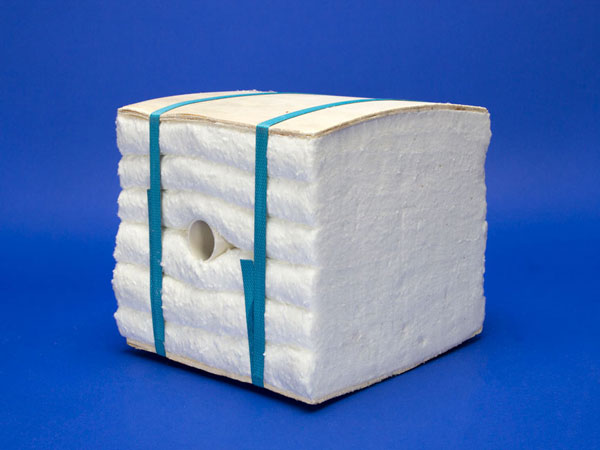
For detailed specifications of our ceramic fiber blanket range, visit our ceramic fiber blanket product page. If your application requires pre-formed shapes, our ceramic fiber modules may be a better fit.
Installation Best Practices
Proper installation is essential to achieving the full performance potential of ceramic fiber blankets. Even the highest-quality blanket will underperform if installed incorrectly.
Proper Handling
Always wear appropriate personal protective equipment including gloves, long sleeves, and a dust mask when handling ceramic fiber blankets. While modern blankets are classified as bio-soluble and pose minimal health risk, the fibers can cause temporary skin irritation. Handle blankets gently to avoid tearing or compressing the fiber structure.
Cutting
Use a sharp utility knife or serrated blade on a clean, flat surface. Cut blankets slightly oversized (5 to 10 millimeters larger than the cavity) to ensure a snug, compression-fit installation. Avoid using saws or abrasive cutting tools that generate excessive dust.
Layering
For multi-layer installations, stagger the joints between layers to eliminate straight-through heat paths. The hot-face layer should be the highest-temperature grade, with lower-cost grades used in backup layers. Secure each layer independently with appropriate mechanical fasteners or high-temperature adhesive.
Anchoring Methods
For wall and roof installations, use welded anchors or threaded studs with ceramic fiber washers to secure blankets. Anchor spacing should be 300 to 400 millimeters apart, with closer spacing in high-velocity gas flow areas. For ceiling installations, reduce spacing to 200 to 250 millimeters to counteract gravity. Always follow the anchoring pattern recommended by your engineering specifications.
Quality Standards and Certifications
When sourcing ceramic fiber blankets, verifying supplier quality credentials protects your investment and ensures consistent product performance.
- ISO 9001 Certification: Confirms the manufacturer operates a certified quality management system with documented processes for production, inspection, and corrective action. ZOUYU holds ISO 9001 certification across all manufacturing facilities.
- SGS Testing: Independent third-party testing by SGS or equivalent laboratories verifies chemical composition, temperature rating, and physical properties against published specifications.
- Consistent Density: Quality blankets maintain uniform density across the entire roll, with variation not exceeding plus or minus 10 percent of the stated value. Request density test certificates with your shipment.
- Shot Content: Lower shot content (non-fibrous particles) indicates higher manufacturing quality. Premium blankets contain less than 15 percent shot content by weight.
- Dimensional Accuracy: Thickness, width, and length should match specifications within tight tolerances. Standard tolerance is plus or minus 2 millimeters for thickness and plus or minus 5 millimeters for width.
Remember: The lowest-priced blanket is rarely the most cost-effective option over the life of your furnace lining. Invest in quality materials from certified manufacturers to minimize unplanned downtime and re-lining costs.
For more information or to request a technical consultation on selecting the right ceramic fiber blanket for your project, contact our engineering team. We provide free application assessments and competitive quotations for projects of any scale.